Viral advice spreads fast, and most of it skips the science. In 2026 research presented at the EADV Congress, almost 95% of viral Korean skincare and glass skin TikTok videos contained at least one potentially misleading claim. As a result, bad advice often shapes a routine before a professional ever sees your skin.
Thank you for reading this post, don't forget to subscribe!That is why skincare myths survive. They sound simple, they come with a quick fix, and they rarely mention the risks. The cost is wasted money, irritated skin and a routine that never fits your skin type.
This guide separates fact from fiction using clinical evidence and hands-on experience. If you want a professional facial treatments plan built on your skin type rather than a trend, start by clearing out the myths below.
10 Common Skincare Myths You Should Stop Believing
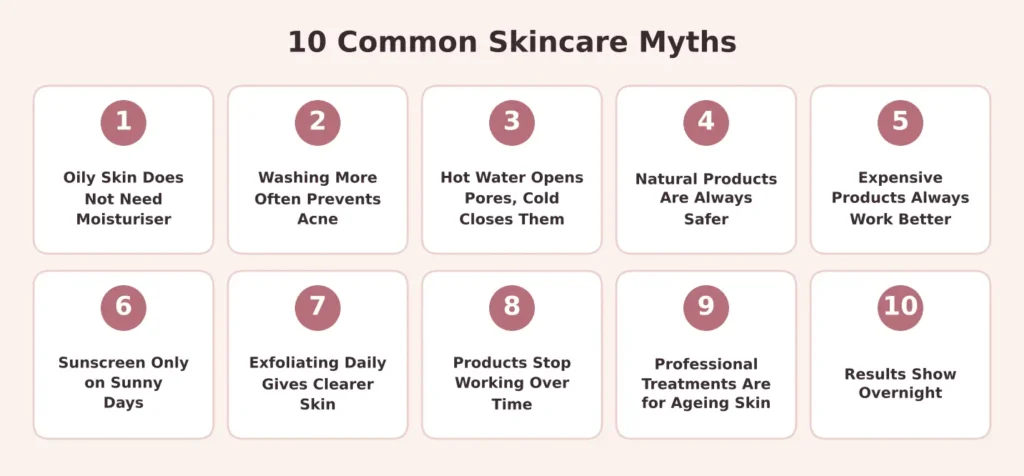
These skincare myths cover cleansing, moisturising, sun protection, exfoliation and treatments. Each one includes the reason it fails and the action to take instead. Use these skincare facts to check your own routine today.
Myth 1: Oily Skin Does Not Need Moisturiser
The fact: Oily skin still needs water. Oil and hydration are different things, so oily skin can feel greasy and still be dehydrated.
Skipping moisturiser leaves skin tight and shiny at the same time. As a result, many people strip it further with harsh cleansers.
Choose an oily skin moisturiser with a light gel or lotion texture. Look for labels such as oil free and non comedogenic. Ingredients like hyaluronic acid and niacinamide add hydration without heaviness.
Myth 2: Washing Your Face More Often Prevents Acne
The fact: Acne comes from excess oil, blocked pores, bacteria and inflammation. Dirt is not the main cause.
Over washing damages your skin barrier, which then leaves skin irritated and more reactive. These skincare misconceptions push people to scrub harder, and acne often worsens as a result.
Follow this simple rule:
- Wash twice a day, morning and evening
- Use a mild, fragrance free cleanser
- Wash again after sweating, then stop
Myth 3: Hot Water Opens Your Pores and Cold Water Closes Them
The fact: Pores have no muscles, so they cannot open or close. Water temperature does not change their size.
Genetics, oil production, age and sun damage set pore size. Heat, however, softens oil and dries skin, while very cold water does nothing for pores at all.
Use lukewarm water instead. It cleans well and protects your skin from dryness and redness. For visibly smaller pores, ingredients like salicylic acid and retinoids work better than any temperature trick.
Myth 4: Natural Skincare Products Are Always Better and Safer
The fact: Natural does not mean gentle. Essential oils, citrus extracts and fragrance from plants are common triggers for contact allergies.
Meanwhile, lab made skincare ingredients such as ceramides, hyaluronic acid and niacinamide have strong safety records. Safety depends on the ingredient, the concentration and your skin, not on where the ingredient comes from. This is one of the skincare myths that marketing keeps alive.
Patch test every new product on your inner forearm for 24 hours. Then add one new product at a time.
Myth 5: Expensive Skincare Products Always Deliver Better Results
The fact: Price reflects branding, packaging and distribution as well as formulation. It does not guarantee results.
Many skin care myths link cost to quality. However, the ingredient list and concentration matter far more than the price tag. A basic moisturiser with ceramides often outperforms a luxury cream built on fragrance.
Judge a product by these points:
- Active ingredients suited to your concern
- Fragrance free formulas for sensitive skin
- Proven, consistent use over several weeks
Myth 6: You Only Need Sunscreen on Sunny Days
The fact: UVA rays pass through cloud and window glass. Therefore, you need sun protection on grey days too.
UV radiation, not heat or brightness, damages skin. In addition, UVA drives ageing and pigmentation all year, even when the weather feels cold. Sunburn is the clearest sign of damage, but harm builds up long before skin turns red.
These sunscreen myths carry the highest cost. Use SPF 30 or higher with a 4 or 5 star UVA rating. Apply about a teaspoon to your face, head and neck, then reapply every two hours in strong sun. Pair it with shade, a wide brimmed hat and sunglasses.
Myth 7: Exfoliating Every Day Gives You Clearer and Smoother Skin
The fact: Daily exfoliation breaks down your protective layer. Redness, stinging and breakouts follow.
Exfoliating skin removes dead cells, but your skin barrier needs recovery time between sessions. Most skin types handle exfoliation one to three times a week. Sensitive skin needs less.
Choose gentle chemical exfoliants like lactic acid over rough scrubs. A clinic option is also available, and our guide on dermaplaning benefits and side effects explains how a sterile blade removes dead skin in one controlled session.
Myth 8: Skincare Products Stop Working When Your Skin Gets Used to Them
The fact: Your skin does not build immunity to skincare ingredients like vitamin C, niacinamide or retinoids.
Retinoid irritation fades as your skin adjusts, which feels like the product stopped working. In reality, the benefits continue. This belief ranks among the most repeated skincare myths because it pushes people to chase new products constantly.
When results stall, look at other causes:
- Seasonal changes in humidity and temperature
- Inconsistent application
- Expired or poorly stored products
- A change in your skin from hormones or stress
Review your routine before you swap products. Constant switching prevents any product from delivering results.
Myth 9: Professional Skin Treatments Are Only for Ageing Skin
The fact: People in their twenties and thirties use professional skin treatments for acne marks, congestion, dullness, dehydration and uneven texture.
Early treatment also supports prevention. For example, a HydraFacial cleanses, exfoliates, extracts and hydrates in one session, and it suits most skin types.
Later on, your needs change. At that stage, skin rejuvenation treatments such as skin boosters and anti wrinkle injections address fine lines and firmness. Age is not the entry requirement. Your skin concern is.
Myth 10: You Can See Results from Skincare Treatments Overnight
The fact: Skin renews itself roughly every 28 days in younger adults, and the cycle slows with age. Real change takes weeks.
Some results appear straight away. For instance, hydration and glow improve after one facial. Structural results like texture, scarring and fine lines need several sessions. A typical microneedling course runs across multiple visits, and our breakdown of microneedling costs in the UK shows what a full course involves.
Be wary of any product or clinic that promises a transformation overnight.
Why Professional Skin Advice Matters More Than Skincare Trends
Trends target the average viewer. Your skin is not average. Professional skincare advice starts with your skin type, your history and your goals. Then it adapts as your skin changes.
Trends Spread Faster Than Evidence
Skincare tips from social media skip the context. A routine that works for one person can irritate another, and short videos rarely mention who the advice suits.
Many skincare myths begin this way. A single result gets shared as a rule, and thousands of people copy it without checking their own skin type, sensitivity or medical history. Therefore, check who gives the advice and what qualifications they hold before you change your routine.
A Skin Assessment Replaces Guesswork
A trained practitioner checks your skin type, hydration, sensitivity and medical history before recommending anything. Consequently, you skip the trial and error that damages the barrier.
A proper assessment also rules out treatments that do not suit you. That includes products that clash with your current routine.
Guidance Keeps Active Ingredients Safe
Layering too many actives causes irritation. Retinoids, exfoliating acids, vitamin C and benzoyl peroxide each work well alone, but combining them without a plan leads to redness, peeling and a weakened barrier.
A specialist tells you which actives to combine, which to separate, and how often to use each one. As a result, you get the benefit of each ingredient without the side effects.
Build a Skincare Routine Based on Facts, Not Myths
A strong daily skincare routine has four steps. Healthy skin responds to consistency and simplicity, not to a ten-step shelf. Keep it short, and add products one at a time.
Cleanse Gently
Use a mild cleanser twice a day. Rinse with lukewarm water and pat dry. Avoid foaming formulas that leave your face tight.
Treat With Targeted Actives
Pick one active for one concern. For instance, use niacinamide for oil control or a retinoid at night for texture. Introduce it two or three nights a week, then build up.
Moisturise Every Day
Every skin type needs moisturiser. Choose gel for oily skin and cream for dry skin. Apply it while your skin is slightly damp to lock in water.
Protect With SPF Daily
Finish every morning with SPF 30 or higher. Our comparison of how professional facials and at home care work together shows how clinic sessions support this daily base.
Personalised Skincare Solutions at Skinfinity Kent
Skinfinity Kent is a skin clinic in Kings Hill, West Malling. Jodie and the team build treatment plans around your skin, not around trends.
You get clear answers on what works and what does not.
Free Consultation With a Skin Specialist
Your consultation covers your skin type, concerns, routine and goals. You leave with honest professional skin advice and a clear plan, whether that plan includes a treatment or only a change to your home routine.
Book online or call the clinic to arrange your visit.
Treatments Matched to Your Skin Concern
The clinic offers facials, advanced skin treatments and anti ageing options. Each one targets a defined concern, such as texture, hydration, pigmentation or fine lines. Therefore, you pay only for what your skin needs.
Conclusion
Clear skin starts with facts. Now that these skincare myths are cleared up, you can build a routine that protects your barrier, hydrates properly and covers you from the sun. For a plan matched to your skin, book a free consultation at Skinfinity Kent.
Frequently Asked Questions
1. What are five common skincare myths?
Five common myths are: oily skin does not need moisturiser, washing more prevents acne, natural products are always safer, expensive products always work better, and sunscreen is only for sunny days. Each one fails under clinical evidence.
2. What are 10 common medical myths?
Ten widely repeated medical myths:
- Cracking knuckles causes arthritis
- You use only 10% of your brain
- Sugar makes children hyperactive
- Everyone needs eight glasses of water daily
- Shaving makes hair grow back thicker
- Cold weather causes colds
- Swallowed gum stays for seven years
- Reading in dim light ruins eyesight
- Antibiotics treat viral infections
- You lose most body heat through your head
3. What Is the Most Common Skincare Myth?
The belief that you only need sunscreen on sunny days ranks highest. UVA reaches your skin through cloud and glass, so daily protection matters in every season.
4. Can Following Skincare Myths Damage Your Skin?
Yes. Over washing, daily exfoliation and skipping sunscreen all damage the skin barrier or raise UV risk. Irritation, redness, breakouts and sun damage are the usual results. Furthermore, relying on myths often delays proper care.
5. How Do I Know If a Skincare Product Is Right for My Skin?
Check the ingredient list against your skin type and concern. Patch test for 24 hours, then introduce only one new product at a time. If irritation lasts beyond a few days, stop using it and ask a professional.
6. How long does it take for skincare treatments to work?
It depends on the treatment. Hydration and glow improve straight away after a facial. Texture, pigmentation and fine lines take several weeks and multiple sessions. A retinoid needs around 12 weeks of regular use to show full results.